
Deixe um recado
Se você está interessado em nossos produtos e deseja saber mais detalhes, deixe uma mensagem aqui, responderemos o mais breve possível.
A farm shed looks like an easy project: open ground, an existing roof, and a load of electricity consumed metres away. Plenty of them still go wrong, and the failure is almost never the modules. It is the structure — the one part of the installation you cannot replace without taking the roof off.
Three things separate a farm shed from a carport: the clear height a working machine needs, the loads that come from people on the roof rather than snow alone, and a corrosive atmosphere that most quotes never mention.
Clear height and span. A carport is designed around a car, roughly 2.5 m clear. A farm shed is designed around the tallest machine that will ever drive under it with a load on — a telehandler, a sprayer with a folded boom, a grain trailer being tipped. That number is rarely in the brief, and it decides the whole frame. Clear spans of 12–18 m are common in machinery and livestock sheds; past roughly 20 m, an intermediate column or a different roof form is the honest answer.
Live load, not just snow. Snow load gets written into the enquiry. What gets missed is drift — snow piling two to three times the uniform load where a wall, a taller building or a tree line sits beside the shed. Add maintenance access (a person and tools at one purlin) and snow clearing, and the calculation is no longer a single number read off a map.
Corrosion. A livestock building is not an outdoor environment in the ordinary sense. Ammonia and slurry put many interiors in ISO 12944 corrosivity category C4–C5, not the C2–C3 assumed for an open rural site. A galvanised coating sized for a field can be intact at twenty years there and showing red rust in a cattle shed in five to eight.
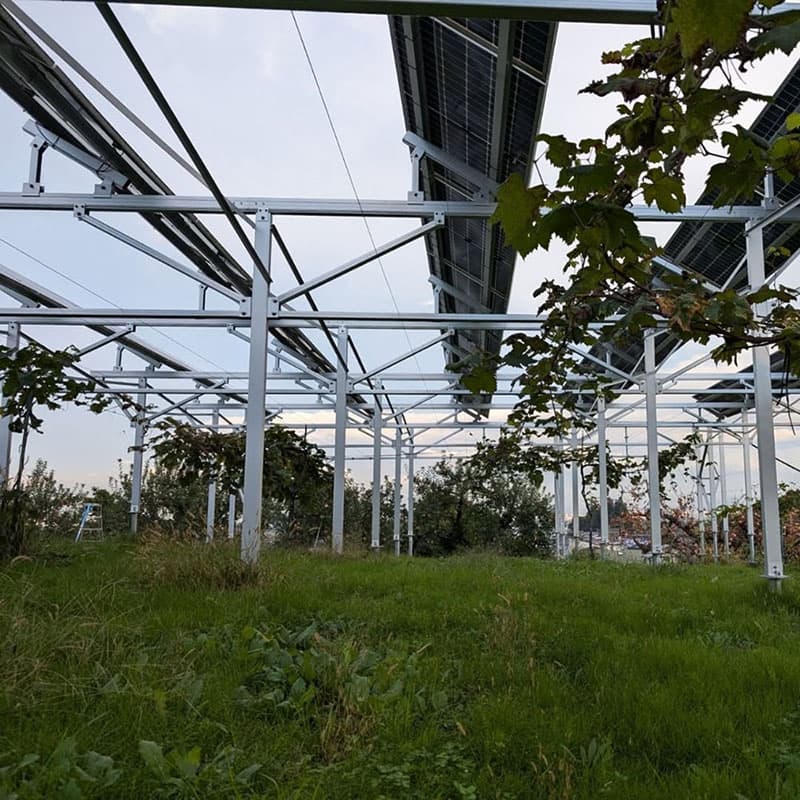
Three forms cover most work:
Then comes the mounting decision. Racking above existing sheeting is the cheapest option where the roof is sound and can carry the added load and wind uplift. Modules used as the roof itself (BIPV) removes a layer, but turns every joint into a waterproofing detail and means walking on modules for maintenance. An independent frame leaves the building untouched — often the only responsible choice for an older shed of unknown load capacity.
Farm ground has a plough layer, a frost depth, and possibly a high water table. Each foundation type answers a different problem:
Four site inputs decide this: frost depth, groundwater level, a soil description, and the required uplift capacity. A quote without them is a guess with a price attached.
Gutters sized for a house overflow on a long agricultural roof. Water lands at the column bases, and the foundation designed for uplift now sits in saturated ground.
Condensation is worse. A shed with livestock or stored feed produces moisture from below; a roof cold outside and warm inside condenses on the underside, and the drip lands on feed, bedding, seedlings or animals. Three measures working together solve it: enough pitch for moisture to run, ventilation at eaves and ridge, and an anti-condensation membrane under the sheeting. Where modules are racked above metal, do not close the ventilation gap.
It is calculated per site: ground snow load, adjusted for roof exposure and thermal condition, plus drift. The same drawing can be adequate in one region and under-designed a hundred kilometres away.
Measure the tallest attachment in transport position and add a working margin. Agricultural sheds commonly end up between 3 m and 4.5 m clear.
Pitch for run-off, ventilate at eaves and ridge, and fit an anti-condensation membrane. In livestock buildings the ventilation requirement usually decides the roof form.
More than for an open field: heavier zinc coating, sealed cut edges, stainless fasteners. Write both coating thickness and salt-spray duration into the order, and check with a gauge on delivery.
Send four things and the answer comes back as a structure, a foundation type and a coating specification: site location with snow load and wind speed, the tallest machine and its height, the building's purpose, and whether the existing roof is to be loaded or spanned. Send a module count instead and the answer comes back as a price per watt — which is where these projects start going wrong.
Cadastre-se em nosso boletim informativo para obter informações atualizadas, promoções e insights.


 Rede IPv6 suportada